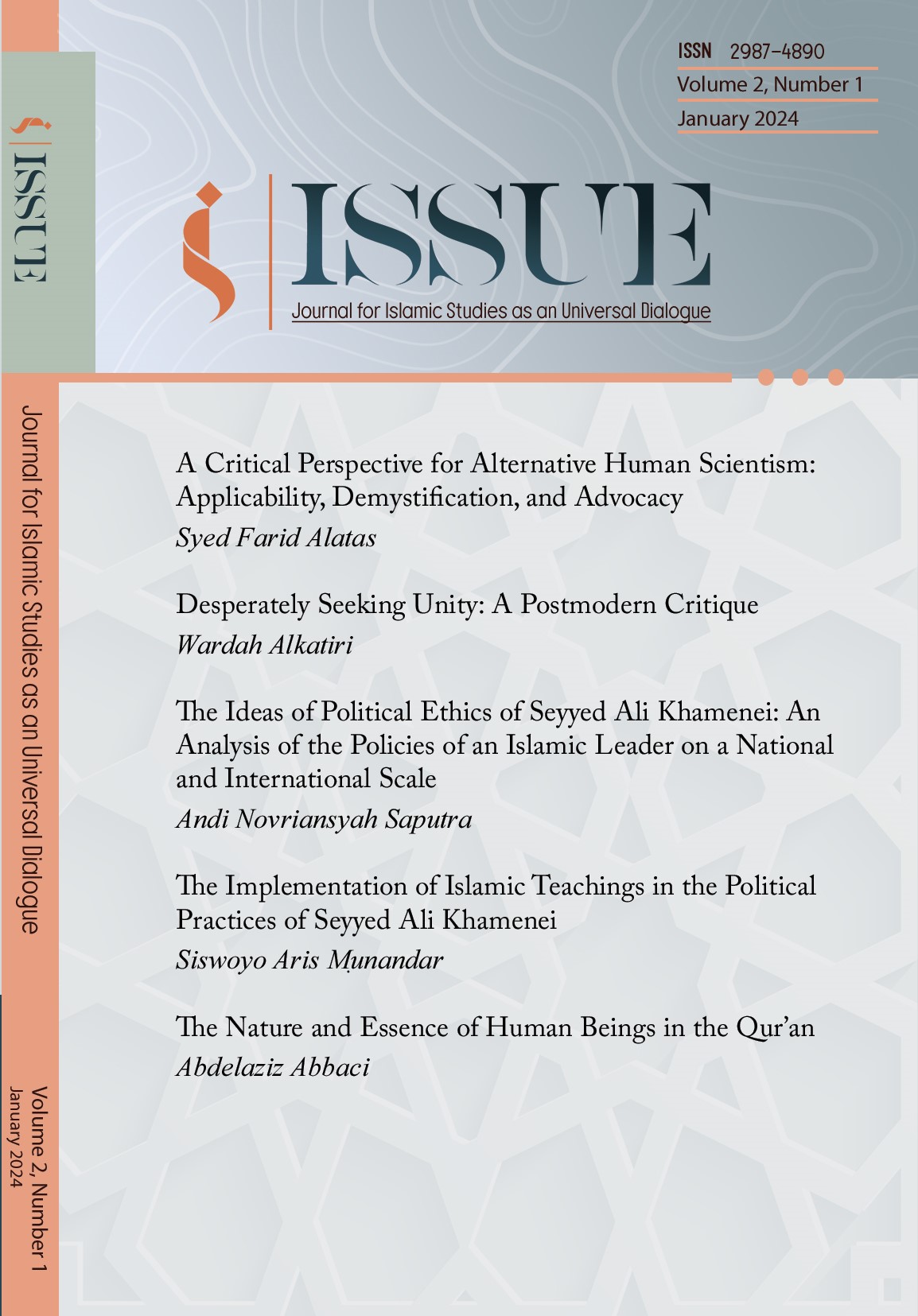
DESPERATELY SEEKING UNITY
A POSTMODERN CRITIQUE
DOI:
https://doi.org/10.67281/issue.v2i1.13Keywords:
Postmodern Critique, Nation Building, Cultural Diversity, Human Rights, Indonesian ArchipelagoAbstract
In the direction of postmodern critique of modern nation-state characterized by, among others, homogeneity of culture and language, this article presents a case study of Indonesia which happened to be the world largest Muslim population. The nation-building process in a deeply pluralistic society of the Indonesian archipelago—of which forcing unity into diversity was a necessity—turned to be one of the greatest paradoxes. Namely: the very idea of unity for the pursuit pursuance of equity contradicts the premise of democracy, because forcing unity into diversity implies denouncing differences, and thus, a violation of human rights to be different. On that account, Indonesia’s struggle with diversity has falsified Huntington’s thesis, according to which cultural differences necessarily tend to lead to conflict. On the contrary, the plain reality of Indonesia demonstratesshows that the conflicts stemmed from nationalism and political-economic ideologies rather than cultural differences. Furthermore, through a reading of the Qur'an, I would like to bring into attention that the rights to be in different ‘traditions’ is associated with the rights to freedom of religion, and is a part and parcel of human dignity in Islam.
References
Alkatiri, Wardah. 2016. “Muhammad’s Nation Is Called: The Potential for Endogenous Relocalisation in Muslim Communities in Indonesia.” New Zealand: Degree of Doctor of Philosophy in Sociology in the University of Canterbury.
Alles, Delphine. 2016. Transnational Islamic Actors and Indonesia’s Foreign Policy: Transcending the State. New York: Routledge.
Anderson, Benedict. 1983. Imagined Communities. Reflections on the Origin and Spread of Nationalism. London: Verso.
Annan, Kofi. 1998. “The Causes of Conflict and the Promotion of Durable Peace and Sustainable Development in Africa.” The Causes of Conflict and the Promotion of Durable Peace and Sustainable Development in Africa Report of the Secretary-General, General Assembly/Security Council, Fifty-second session, A/52/871-S/1998/318. New York. https://www.un.org/en/africarenewal/sgreport/peace.htm.
Aritonang, J.S., and K.A. Steenbrink. 2008. A History of Christianity in Indonesia. Leiden: BRILL.
Barker, Ernest. 1951. Principles of Social and Political Theory. Oxford: Clarendon Press.
Bodley, John H. 1990. Victims of Progress. 3th ed. California: Mayfield Publishing.
Bruinessen, Martin van, ed. 2013. Contemporary Developments in Indonesian Islam: Explaining the “Conservative Turn.” Singapore: Institute of Southeast Asian Studies.
Budiman, H. 2014. “Renegotiating Unity and Diversity: Multiculturalism in Post-Suharto Indonesia.” In Nations, National Narratives, and Communities in Asia Pacific. New York: Routledge.
Deng, Francis M. 1997. “Ethnicity: An African Predicament.” The Brookings Review 15 (3): 28–31.
Dersso, S.A. 2012. Taking Ethno-Cultural Diversity Seriously in Constitutional Design. A Theory of Minority Rights for Addressing Africa’s Multiethnic Challenge. Leiden: Martinus Nijhoff.
Evers, G. 2014. “On the Trail of Spices: Christianity in Southeast Asia. Common Traits of the Encounter of Christianity with Societies, Cultures and Religions in Southeast Asia.” In The Oxford Handbook of Christianity in Asia. Oxford: Oxford University Press.
Featherstone, Mike. 1991. Consumer Culture and Postmodernsim. Los Angeles: SAGE Publications.
Gellner, Ernest. 1983. Nations and Nationalism. New York: Cornell University Press.
Hasbullah, M. 2002. “Cultural Presentation of the Muslim Middle Class in Contemporary Indonesia.” STUDIA ISLAMIKA: Indonesian Journal for Islamic Studies 7 (2).
Intan, B.F. 2006. “Public Religion” and the Pancasila-Based State of Indonesia. An Ethical and Sociological Analysis. Bern: Peter Lang.
Kamali, Muhammad H. 2012. “Human Dignity in Islam.” 2012. http://islamicstudies.islammessage.com/Article.aspx?aid=534.
Kymlicka, W. 1995. Multicultural Citizenship: A Liberal Theory of Minority Rights. New York: Oxford University Press.
Latif, Yudi. 2008. Indonesian Muslim Intelligentsia and Power. Singapore: Institute of Southeast Asian Studies.
Nasr, Seyyed Hossein. 1994. Traditional Islam in the Modern World. London: Kegan Paul International.
Nasr, Seyyed Vali Reza. 2001. Islamic Leviathan. Islam and the Making of State Power. New York: Oxford University Press.
Nkrumah, Kwame. 1961. I Speak of Freedom: A Statement of African Ideology. London: Heinemann.
Noer, Deliar. 1987. Partai Islam Di Pentas Nasional. Jakarta: Grafiti Pers.
Nwabueze, Benjamin O. 1973. Constitutionalism in the Emergent States. New Jersey: Fairleigh Dickinson University Press.
Pringle, Robert. 2010. Understanding Islam in Indonesia. Politics and Diversity. Singapore: Didier Millet.
Renan, Ernest. 1882. “Qu’est-Ce Qu’ Une Nation?” In Oeuvres Complètes. Vol. 1.
Ricklefs, M. C., Bruce Lockhart, Albert Lau, Portia Reyes, and Maitri Aung Thwin. 2010. A New History of Southeast Asia. Basingstoke: Palgrave Macmillan.
Rousseau, Jean-Jacques. 1968. The Social Contract. New York: Penguin Group.
Setyawan, Y.B. 2014. “Encountering State Ideology: Reading the Bible from an Indonesian Postcolonial Perspective.” In Colonial Contexts and Postcolonial Theologies. New York: Palgrave McMillan.
Setyo, Bambang. 2011. Telaah Kritis Dasar Falsafah Negara Republik Indonesia. Jakarta: Masyarakat Peduli Syariah.
Simatupang, Tahi Bonar. 1985. “Christian Presence in War, Revolution and Development: The Indonesian Case.” The Ecumenical Review 37 (1): 75–85.
Sulaiman, Yohanes. 2011. “Pancasila Isn’t What It Used to Be.” 2011. http://jakartaglobe.beritasatu.com/archive/pancasila-isnt-what-it-used-to-be/.
Taylor, Charles. 1998. “Nationalism and Modernity.” In The State of the Nation: Ernest Gellner and the Theory of Nationalism. Cambridge: Cambridge University Press.
Touré, Ahmed Sékou. 1959. Toward Full Re-Africanisation: Policy and Principles of the Guinea Democratic Party. paris: Présence africaine.