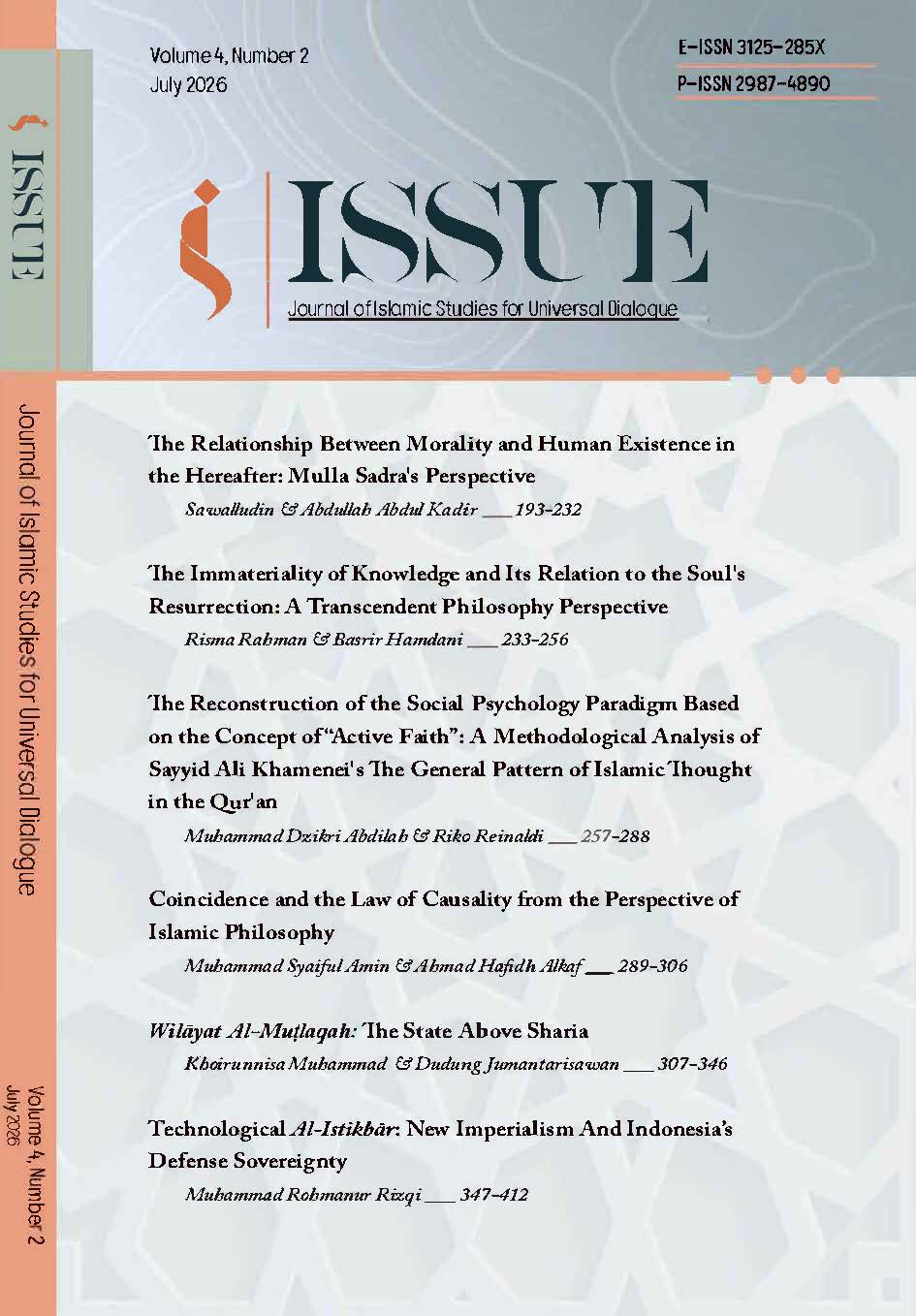
COINCIDENCE AND THE LAW OF CAUSALITY FROM THE PERSPECTIVE OF ISLAMIC PHILOSOPHY
DOI:
https://doi.org/10.67281/issue.v4i2.61Keywords:
Coincidence, Causality, Islamic Philosophy, Cause and Effect, BurhānAbstract
Coincidence is often understood as an event that occurs without a cause. However, this understanding contradicts the law of causality in Islamic philosophy, which asserts that every effect necessarily has a cause. This study aims to address the possibility of a causeless coincidence, the position of coincidence in Islamic philosophy, and the philosophical consequences of regarding coincidence as an event that genuinely occurs without a cause. This study employs a qualitative approach based on document or textual study, emphasizing an in-depth analysis of written materials within their respective contexts. The primary sources include the works of Islamic philosophers such as Avicenna, al-Farabi, and Averroes. The analysis applies the method of rational demonstration (burhān) through logical reasoning and the use of verifiable facts and textual evidence. The findings indicate that absolute coincidence is not recognized in Islamic philosophy because all phenomena are subject to the law of cause and effect. Coincidence is merely relative, arising from the limitations of human reason in comprehending hidden causal relationships. Therefore, every event still has a cause, and coincidence must be understood within the framework of causality. Further research is expected to examine the relationship between causality and probability in modern science.
References
Adian, Gahral Donny. 2002. Menyoal Objektivisme Ilmu Pengetahuan. Teraju.
Agustinova, Danu Eko. 2015. Memahami Metode Penelitian Kualitatif: Teori dan Praktik. Calpulis.
Al-Dinani, Ghulam Husain Ibrahim. 2007. Al-Qawā’id al-Falsafiyyah al-‘āmmah fī al-Falsafah al-Islāmiyyah. Perpustakaan Mukmin Quraisy.
Aulia, Yaumil Wafa, dan Husein Alkaff. 2023. “Hukum Kausalitas sebagai Dasar Onto-Epistemologis Mukjzat Pespektif Allamah Ṭabāṭabā’ī.” Nizham Journal of Islamic Studies 11 (1): 79–93. https://doi.org/10.32332/nizham.v11i01.6704.
Bisri, Bisri. 2017. “Hukum-Hukum Determinisme dalam Filsafat Sejarah Ibnu Khaldun: Dialektika antara Sains dan Teologi.” Jurnal Yaqzhan: Analisis Filsafat, Agama dan Kemanusiaan 3 (1): 1–15. https://doi.org/10.24235/jy.v3i1.2036.
Erlwein, Hannah C. 2024. “Ibn Sīnā on Proving Causality.” Arabic Sciences and Philosophy 34 (2): 209–31. https://doi.org/10.1017/S0957423924000031.
Firdiansyah, Adin Lazuardi, dan Yuliana Alfiyatin. 2023. “Kausalitas dalam Perspektif Teologi dan Filsafat Al-Ghazali.” EL-BANAT: Jurnal Pemikiran dan Pendidikan Islam 13 (2): 254–71. https://doi.org/10.54180/elbanat.2023.13.2.254-271.
Ikram, Rafi Mhd. dan Syamsuwir Syamsuwir. 2022. “Sunnatullah dalam Perspektif Al-Quran Menurut Ahmad Mustafa Al-Maraghi dan Buya Hamka.” Lathaif: Literasi Tafsir, Hadis dan Filologi 1 (1): 79–89. https://doi.org/10.31958/lathaif.v1i1.5748.
Keraf, A. Sonny, dan Mikhael Dua. 2001. Ilmu Pengetahuan: Sebuah Tinjauan Filosofis. Kanisius.
Mulla Sadra. 2002. Filsafat Hikmah: Pengantar Pemikiran Shadra. Mizan Media Utama (MMU).
Muthahari Murtadha, 2010. Pengantar Filsafat Islam: Filsafat Teoritis & Filsafat Praktis. RausyanFikr Institute.
Muthahari, Murtadha, 2019, Teori Pengetahuan: Catatan Kritis atas Berbagai Isu Epistemologi. Sadra Press.
Prawironegoro, Darsono. 2011. Filsafat Ilmu: Kajian tentang Pengetahuan yang Disusun secara Sistematis dan Sistemik dalam Membangun Ilmu Pengetahuan. Nusantara Consulting.
Salem, Maryam, dan Reza Akbarian. 2007. “Bakht va Ittifāq az Dīdgāh-e Ibn Sīnā.” Ḥikmat-e Sīnavī (Mishkāt al-Nūr) 11 (38): 150–68.
Sofian, Ahmad, 2018. Ajaran Kausalitas dalam Hukum Pidana. Prenada Media.
Stein, Nathanael. 2012. “Causal Necessity in Aristotle.” British Journal for the History of Philosophy 20 (5): 855–79. https://doi.org/10.1080/09608788.2012.718871.
Subhani, Ja‘far. 2012. “Bakht va Ittifāq.” Kalām-e Islāmī 21 (81): 5–13. https://www.kalamislami.ir/article_61803.html?utm.
Thabathaba’i, Sayyid Muhammad Husain. 2020. Seri Metafisika Islam: Terjemah Dan Syarah Bidayah Al-Hikmah. Diterjemahkan oleh Muhammad Adlany & Budi Sulistyo. Zahir Publishing.
Widiadharma, Novian, Lasiyo, dan Sindung Tjahjadi. 2023. “Teori Kausalitas Aristotelian.” Living Islam: Journal of Islamic Discourses 6 (1): 71-87. https://doi.org/10.14421/lijid.v6i1.4397.
Yatsribi, Sayyid Yahya. 2009. Tārīkh-e Taḥlīlī-Entiqādī-ye Falsafeh-ye Eslāmī [Sejarah analitis-kritis filsafat Islam]. Sāzmān-e Enteshārāt-e Pazhūheshgāh-e Farhang va Andīsheh-ye Eslāmī.
Zed, Mestika. 2018. “Tentang Konsep Berfikir Sejarah.” Lensa Budaya: Jurnal Ilmiah Ilmu-Ilmu Budaya 13 (1): 54–60. https://doi.org/10.34050/jlb.v13i1.4147.
Zikri, Abdalul, Syuaib Jailuddin, Marilang M., dan M. Nasir Siola. 2025. “Hukum Kausalitas dalam Perspektif Pengembangan Ilmu Pengetahuan Modern.” Socius: Jurnal Penelitian Ilmu-Ilmu Sosial 2 (6): 137–43.
Downloads
Published
Issue
Section
License
Copyright (c) 2026 M. Syaiful Amin, Ahmad Hafidh Alkaf (Author)

This work is licensed under a Creative Commons Attribution 4.0 International License.