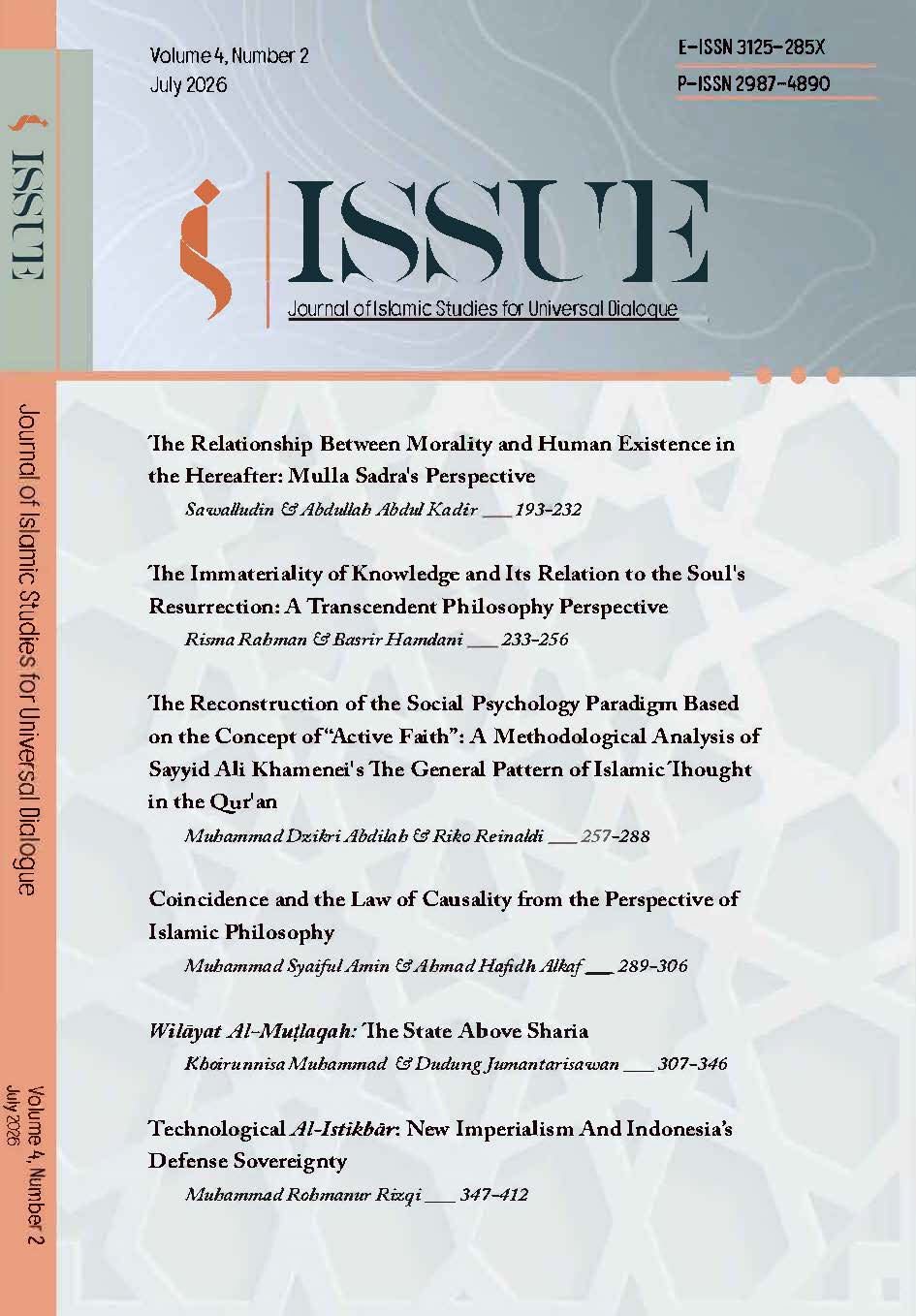
THE IMMATERIALITY OF KNOWLEDGE AND ITS RELATION TO THE SOUL'S RESURRECTION
TRANSCENDENT PHILOSOPHY PERSPECTIVE
DOI:
https://doi.org/10.67281/issue.v4i2.64Keywords:
Immateriality of Knowledge, Mulla Sadra, Resurrection of the Soul, Subject of Knowledge, Transcendental PhilosophyAbstract
The question of whether human knowledge persists after death remains a significant philosophical issue, particularly in debates between materialist and metaphysical perspectives. Materialist thinkers generally argue that knowledge ceases with the termination of brain function and consciousness, whereas metaphysical traditions maintain the continuity of knowledge beyond bodily existence. This study aims to analyze the immaterial nature of knowledge in relation to the resurrection of the soul from the perspective of Transcendental Philosophy. Employing a qualitative library research method, this study uses an interpretive content analysis approach to examine relevant philosophical texts, with the theoretical framework grounded in Mulla Sadra’s Transcendental Philosophy. The findings indicate that knowledge is not merely a product of material brain processes but possesses an immaterial nature inherent in the soul as the knowing subject. Consequently, knowledge does not perish when the soul separates from the body but persists in accordance with the soul’s immaterial existence. Furthermore, the continuity of knowledge after bodily death is understood as part of the soul’s ontological journey toward perfection. This study concludes that, within the framework of Mulla Sadra’s philosophy, the persistence of knowledge after death is philosophically defensible because knowledge shares the immaterial nature of the soul itself, thereby reinforcing the metaphysical understanding of post-mortem human existence.
References
Adil, Muhammad. 2024. “Respons Muhammad Taqi Mishbah Yazdi Terhadap Pola Pikir Materialisme.” Maqamat: Jurnal Ushuluddin dan Tasawuf 2 (2): 78-93.
Al-Mandary, Mustamin. 2018. Menuju Kesempurnaan, Pengantar Pemikiran Mullā Ṣadra. 1 ed. Rumah Ilmu.
Al Walid, Kholid. 2012. Perjalanan Jiwa Menuju Akhirat: Filsafat Eskatologi Mulla Sadra. Sadra Press.
Al Walid, Kholid. 2020. “Hushūlī dan Hudhūrī Dalam Konteks Filsafat Hikmat Muta’aliyyah.” Jurnal Yaqzhan 6 (2): 163-175. https://doi.org/10.24235/jy.v6i2.7117.
Anggito, Albi, dan Johan Setiawan. 2018. Metode Penelitian Kualitatif. CV Jejak.
Bagir, Haidar. 2005. Mengenal Filsafat Islam: Pengantar Filsafat Islam yang Ringkas, Menyeluruh, Praktis, dan Transformatif. Mizan.
Bagus, Lorens. 2002. Kamus Filsafat. Gramedia PustakaUtama.
Heil, John. 1998. Philosophy of Mind (A Contemporary Introduction). Routledge.
Jannah, Nur. 2016. Penyempurnaan Eksistensi Jiwa Melalui Ittihad al-‘Aql Wa al-Ma‘qūl Perspektif Hasan Zadeh Amuli. Skripsi. Sekolah Tinggi Agama Islam Sadra.
Juliardi, Budi, Pristiyanto Pristiyanto, Febrina Riska Putri, dkk. 2023. Filsafat Ilmu. CV. Gita Lentera.
Kaelan. 2005. Metode Penelitian Kualitatif Bidang Filsafat. Paradigma.
Kalin, Ibrahim. 2010. Knowledge in Later Islamic Philosophy: Mullā Ṣadra on Existence, Intellect, and Intuition. Oxford University Press.
Kartanegara, Mulyadhi. 2005. Integrasi Ilmu (Sebuah Rekontruksi Holistik). Arasy Mizan.
Keraf, A. Sonny, dan Mikhael Dua. 2001. Ilmu Pengetahuan: Sebuah Tinjauan Filosofis. Kanisius.
Khair, Nurul. 2021. “Konsep al-‘Ilm dalam Studi Pemikiran Filsafat Mullā Ṣadra.” Substantia: Jurnal Ilmu-Ilmu Ushuluddin 23 (2): 90-107.
Kosim, Mohammad. 2008. “Ilmu Pengetahuan Dalam Islam (Perspektif Filosofis-Historis).” Tadrîs 3 (2): 121-140. https://doi.org/10.19105/tjpi.v3i2.232.
M, Afrizal. 2014. “Pemikiran Para Filosof Muslim Tentang Jiwa.” Jurnal Pemikiran Islam 39 (1): 1-17. https://doi.org/10.24014/an-nida.v39i1.860.
Madkour, Ibrahim. 1991. Fi al-Falsafah al-Islamiyah Manhaj Wa Tathbiquh. Rajawali.
Mardalis. 2014. Metode Penelitian (Suatu Pendekatan Proposal). 1 ed. Bumi Aksara.
Mariyono, Dwi. 2024. Menguasai Penelitian Kualitatif. Cipta Media Nusantara.
Mishbah Yazdi, Taqi. 2010. Buku Daras Filsafat Islam. 1. Sadra Press.
Munawwir, A. W., dan Muhammad Fairuz. 2007. Kamus al-Munawwir versi Indonesia Arab. 1. Pustaka Progressif.
Muthahhari, Murtadha. 2019. Teori Pengetahuan: Catatan Kritis Atas Berbagai Isu Epistemologis. Sadra Press.
Nasr, Hossein. 2017. Al-Hikmah Al-Muta’aliyah Mulla Sadra. 1. Sadra Press.
Nasution, Hasyimsyah. 2002. Filsafat Islam. Gaya Media Pratama.
Neonnub, Patricius. 2023. “Pandangan Thomas Aquinas Tentang Identitas Manusia dan Hubungan Jiwa-Badan dalam Doktrin Kebangkitan Badan.” Fides et Ratio: Jurnal Teologi Kontekstual Seminari Tinggi St. Fransiskus Xaverius Ambon 8 (2): 63-78. https://doi.org/10.47025/fer.v8i2.
Nurabdiah Pratiwi, Sri. 2022. Pengetahuan dan Nilai. 1. Umsu Press.
Putri Serena, Debi, Siti Umi Hani, Bunga Septria Vionita, and Badru Sohim. 2023. “Konsep Jiwa Perspektif Ibnu Sina”. Media: Jurnal Filsafat Dan Teologi 4 (1):83-90. https://doi.org/10.53396/media.v4i1.161.
Raco, J. R. 2010. Metode Penelitian Kualitatif: Jenis dan Keunggulannya. PT Grasindo.
Rahman, Fazlur. 2000. Filsafat Shadra. 1. Penerbit Pustaka.
Rezaee Hossein, Sheykh, dan Mohammad Mansur Hashemi. 2009. “Knowledge as a Mode of Being: Mullā Ṣadra’s Theory of Knowledge.” Sophia Perennis, 6 (4): 19–42. https://www.sid.ir/En/Journal/ViewPaper.aspx?ID=196052.
Sadra, Mulla. 1981a. Al-Ḥikmah al-Muta‘āliyyah fī al-Asfār al-‘Aqliyyah al-Arba’ah. 3 ed. Vol. 8. Dār al-Iḥyā al-Turāth.
Sadra, Mulla. 1981b. Al-Ḥikmah al-Muta‘āliyyah fī al-Asfār al-‘Aqliyyah al-Arba’ah. 3 ed. Vol. 9. Dār al-Iḥyā al-Turāth.
Sadra, Mulla. 1981c. Al-Shawāhid al-Rubūbiyyah fī al-Manāhij al-Sulūkiyyah. 2 ed. Vol. 1. Chāpkhānah-i Dānishgāh-i Mashhad.
Sadra, Mulla. 2004. Kearifan Puncak. 2. Pustaka Pelajar.
Sadra, Mulla. 2008. Spiritual Psychology. Vol. 8 dan 9. ICAS Press.
Sapuri, Rafy. 2017. Psikologi Islam: Tuntutan Jiwa Manusia Modern. 1 ed. 2. Rajawali Press.
Shadr, Muhammad Baqir. 1987. Falsafatuna: Pandangan Terhadap Pelbagai Aliran Filsafat Dunia. Mizan.
Sīna, Ibnu. 2022. Psikologi Islam. 2. Rene Turos Indonesia.
Soelaiman, Darwis A. 2019. Filsafat Ilmu Pengetahuan Perspektif Barat dan Islam. Bandar Publishing.
Suriasumantri, Jujun. 2009. Filsafat Ilmu Sebagai Sebuah Pengantar Populer. Pustaka Sinar Harapan.
Syamsul Huda, Mukhamad. 2009. Pandangan al-Ghazali Tentang Kebangkitan Jasmani Dalam Kitab Tahafut al-Falasifah. Skripsi. Universitas Islam Negeri Sunan Kalijaga.
Universitas Sains dan Teknologi Komputer. 2005. “Materialisme.” Ensiklopedia Dunia. Diakses 25 Februari 2025. https://p2k.stekom.ac.id/ensiklopedia/Materialisme#cite_note-Driyarkara-2.
Utsman Najati, Muhammad. 2002. Jiwa Dalam Pandangan Para Filosof Muslim. 1. Pustaka Hidayah.
Warno, Nano, dan Nurul Ayn. 2021. “Insan Ilahiyah dalam Perspektif Filsafat Transendental Mullā Ṣadra.” Emanasi: Jurnal Ilmu Keislaman dan Sosial 4 (1): 1-15.
Weya, Herwanto, dan Henrycus Napitsunargo. 2024. “Makna Kematian dalam Perspektif Kierkegaard & Al-Ghazali: Korelasi dan makna antara Kehidupan serta Kematian.” Integritas Terbuka: Peace and Interfaith Studies 3 (2): 99-110. https://doi.org/10.59029/int.v3i2.35.
Downloads
Published
Issue
Section
License
Copyright (c) 2026 Risma Rahman, Basrir Hamdani (Author)

This work is licensed under a Creative Commons Attribution 4.0 International License.