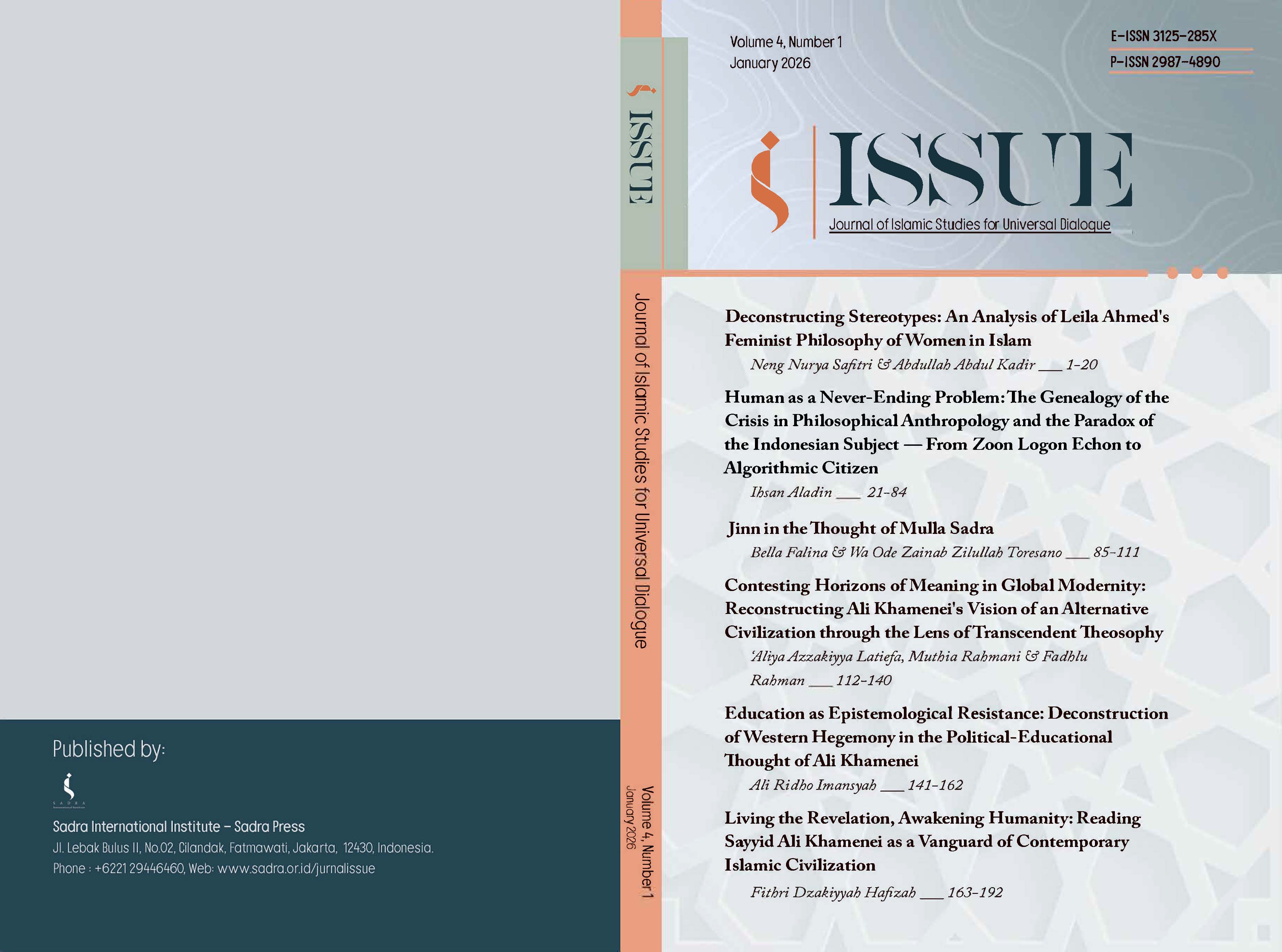
LIVING THE REVELATION, AWAKENING HUMANITY
READING SAYYID ALI KHAMENEI AS A VANGUARD OF CONTEMPORARY ISLAMIC CIVILIZATION
DOI:
https://doi.org/10.67281/issue.v4i1.68Keywords:
Sayid Ali Khamenei, Western Hegemony, Revelation (Waḥy), Humanity, Islamic CivilizationAbstract
Sayyid Ali Khamenei is a globally scrutinized figure with a unique public image. He is not only deeply revered but also viewed as a highly controversial leader. His death has sparked a wave of global attention far more massive than ever before. Current global responses tend to polarize into two mainstream currents: Western narratives are oriented toward a negative essentialism that views Sayyid Ali Khamenei’s leadership as rigid and oppressive. On the other hand, the narratives of his supporters tend to be confined within a positive essentialism that views his leadership as flawless, entirely devoid of internal dynamics. This epistemological impasse is the central problem this study seeks to untangle. To achieve this, this paper employs a qualitative content analysis method to dismantle the gap between these simplistic global narratives and the originality of his notions and actions throughout his leadership trajectory. This study attempt to map the dynamics of Khamenei’s thought within the context of post-revolutionary domestic tensions, while simultaneously capturing how Islamic principles and divine revelation are inclusively contextualized into modern realities. Through a decolonial analytical framework, this study argues that Sayyid Ali Khamenei’s thought cannot be reduced to a rigid form of theocracy. Instead, he offers a dynamic contemporary Islamic paradigm for transforming revelation into a system of governance, where Islamic and human values serve as the core foundation for establishing a humanizing social justice; one that both honours human dignity and drives the resurgence of Islamic civilization in the contemporary era.
References
Abusharaf, Rogaia. 2013. Social Change in Post-Khomeini Iran. No. 10. Center for International and Regional Studies.
Aleyamin, Hamed, Mohammad Hadi Aleyamin, Mohammad Hosein Mokhtari, and Majid Qorbanali Doulabi. 2021. “Analysis of the Accompaniment of Justice and Politics in Imam Khamenei’s Political Jurisprudential Thought.” Pt. 27-42. Journal of Contemporary Research on Islamic Revolution 3 (10).
Alfoneh, Ali. 2018. Political Succession in the Islamic Republic of Iran: The Rise of the Revolutionary Guards. (Washington) 1 (1).
Al Jazeera (Al Jazeera). 2026. “Photos: Tens of Thousands in Iran Mourn Khamenei’s Killing.” https://www.aljazeera.com/gallery/2026/3/1/thousands-in-iran-mourn-khameneis-killing.
Amirpur, Katajun. 2015. New Thinking in Islam: The Jihad for Democracy, Freedom and Women’s Rights. Gingko Library.
Arif, M. Syamsul, ed. 2026. Dinamika Pemikiran Sayid Ali Khamenei Menjawab Tantangan Masa Kini. Sadra Press.
Britannica. 2026. “Global North and Global South | Definition, Countries, Differences, History, Map, & Facts.” https://www.britannica.com/topic/Global-North-and-Global-South.
Bryman, Alan. 2022. Social Research Methods. Oxford University Press.
Buonomo, Thomas. 2018. Iran’s Supreme Leader: An Analysis of His Hostility Toward the U.S. and Israel. XXV (1): 33–45.
Chaitanya, Rachna. 1995. The New World Order. Radiant Publisher.
Daniller, Andrew. 2026. “Americans Remain Critical of Trump Administration’s Approach to Iran.” Political Issues. Pew Research Center, May 1. https://www.pewresearch.org/short-reads/2026/05/01/americans-remain-critical-of-trump-administrations-approach-to-iran/.
Elmi, Zahra Mila. 2009. “Educational Attainment in Iran.” Middle East Institute. https://mei.edu/publication/educational-attainment-iran/.
Ganji, Akbar. 2013. “Who Is Ali Khamenei? The Worldview of Iran’s Supreme Leader.” Foreign Affairs 92 (5): 24–48.
Ḫalaǧī, Mahdī. 2023. The Regent of Allah: Ali Khamenei’s Political Evolution in Iran. With Washington Institute for Near East Policy. Rowman & Littlefield.
Hovsepian-Bearce, Yvette. 2016. The Political Ideology of Ayatollah Khamenei: Out of the Mouth of the Supreme Leader of Iran. UCLA Center for Middle East Development (CMED) Series 9. Routledge. https://doi.org/10.4324/9781315748351.
Kadivar, Mohsen. 2011a. “From Traditional Islam to Islam as an End in Itself.” Die Welt Des Islams 51 (3–4): 459–84. https://doi.org/10.1163/157006011X611632.
Kadivar, Mohsen. 2011b. “Wilayat Al-Faqih and Democracy.” In Islam, the State, and Political Authority: Medieval Issues and Modern Concerns, 1st ed, edited by Asma Afsaruddin. Middle East Today. Palgrave Macmillan.
Kadivar, Mohsen. 2015. “Ijtihad in Usul Al-Fiqh: Reforming Islamic Thought through Structural Ijtihad.” XX-XXVII. Iran Nameh 30 (3).
Khamenei, Ayatollah Seyyid Ali. 1990. The General Pattern of Islamic Thoughtin the Qur’an. Islamic Propagation Organization.
Khamene’i, Ayatullah Sayyid Ali. 1983. Lessons from the Nahjul Balaghah. Translated by Hossein Vahid Dastjerdi. Al-Islam.org.
Khamenei, Sayid Ali. 2021. Cell No. 14. Amin Publication.
Khamenei, Sayid Ali. 2014. A 250 Years Old Person, Statements and Expressionsof the Great Leader and Guardian On the Political Combats and Stuggles of Infallible Imams. Lebanan.
Khamenei.ir (KHAMENEI.IR). 2015. “Enemies Trying to Infiltrate Decision Makers.” https://en.khamenei.ir/news/139144.
Khamenei.ir (Khamenei.Ir). 2017a. “The Islamic Revolution Is a New Idea for Humanity’s Life.” https://en.khamenei.ir/news/139046.
Khamenei.ir (KHAMENEI.IR). 2017b. “The Islamic Revolution Moved the People into the Center of Political Decision Making.” https://en.khamenei.ir/news/139065.
Khamenei.ir (KHAMENEI.IR). 2020. “The Three Main Elements of the Islamic Model for Governing: Faith, Knowledge & Justice.” https://en.khamenei.ir/news/138909.
Khamenei.ir (KHAMENEI.IR). 2025. “The Islamic Republic Has Refuted Western Logic Regarding the Issue of Women.” https://en.khamenei.ir/news/149044.
Lawrence, Bruce B. 2021. The Bruce B. Lawrence Reader: Islam beyond Borders. Edited by Ali Altaf Mian. Duke University Press.
Malakouti, Zeynab. 2026. “The Khamenei Succession: Hereditary Power and Democracy in Iran.” IAI Commentaries 14 (26).
Mamdani, Mahmood. 2005. Good Muslim, Bad Muslim: America, the Cold War, and the Roots of Terror. Potter/Ten Speed/Harmony/Rodale.
Matthiesen, Toby (The Jakarta Post). 2026. “God on Their Side: Faith in the Politics of War - Academia.” https://www.thejakartapost.com/opinion/2026/04/01/god-on-their-side-faith-in-the-politics-of-war.html.
Mignolo, Walter, and Catherine E. Walsh. 2018. On Decoloniality: Concepts, Analytics, Praxis. On Decoloniality. Duke University Press.
Mousavi, Seyed Hadi, Seyed Ahmadreza Shahrokhi, and Nasibeh Ghodsifar. 2024. “The nature and role of spirituality in modern Islamic civilization from the point of view of Ayatollah Khamenei.” Scientific Journal Of New Islamic Civilization Fundamental Studies (IR), no. Online First (February). https://doi.org/10.22070/nic.2024.18493.1281.
Munandar, Siswoyo Aris. 2024. “The Implementation of Islamic Teachings in the Political Practices of Seyyed Ali Khamenei.” ISSUE: Journal of Islamic Studies for Universal Dialogue 2 (1): 87–122.
Murphy, John. 2008. Ali Khamenei. Modern World Leaders. Chelsea House.
Nomani, Mohammad Manzoor. 1988. Khomeini, Iranian Revolution and the Shi’ite Faith. Furqan Publications.
Putra, Riko. 2024. “Equality Towards a Civil Society: Analysis of Individual Quality Towards Seyyed Ali Khamene’i’s National Identity.” ISSUE: Journal of Islamic Studies for Universal Dialogue 2 (2): 79-113.
Sadjadpour, Karim. 2009. Reading Khamenei: The World View of Iran’s Most Powerful Leader. Carnegie Endowment for International Peace.
Said, Edward W. 1979. Orientalism. Vintages books.
Saputra, Andi Novriansyah. 2024. “The Ideas of Political Ethics of Seyyed Ali Khamenei: An Analysis of The Policies of An Islamic Leader on a National and International Scale.” ISSUE: Journal of Islamic Studies for Universal Dialogue 2 (1): 61–84.
Situmorang, Mangadar (The Jakarta Post). 2026. “Autocratic and Self-Interest Driven Leadership Started the Iran War - Academia.” https://www.thejakartapost.com/opinion/2026/03/12/autocratic-and-self-interest-driven-leadership-started-the-iran-war.html.
Smith, Jason A. 2017. “Textual Analysis.” In The International Encyclopedia of Communication Research Methods, 1st ed., edited by Jörg Matthes, Christine S. Davis, and Robert F. Potter. Wiley. https://doi.org/10.1002/9781118901731.iecrm0248.
Vatanka, Alex. 2008. “‘Ali Khamene’i: Iran’s Most Powerful Man.” The Middle East Institute, no. 10 (March).
Wahyuni, Willa (hukumonline.com). 2026. “Pemicu Serangan AS-Israel ke Iran: Ancaman Nuklir dan Politik Regional.” https://www.hukumonline.com/berita/a/pemicu-serangan-as-israel-ke-iran--ancaman-nuklir-dan-politik-regional-lt69a5698e46ec0/.
Wurr, Julia. 2022. Literary Neo-Orientalism and the Arab Uprisings: Tensions in English, French and German Language Fiction. Edinburgh Studies of the Globalised Muslim World. Edinburgh university Press.
Downloads
Published
Issue
Section
License
Copyright (c) 2026 ISSUE: Journal of Islamic Studies for Universal Dialogue

This work is licensed under a Creative Commons Attribution 4.0 International License.