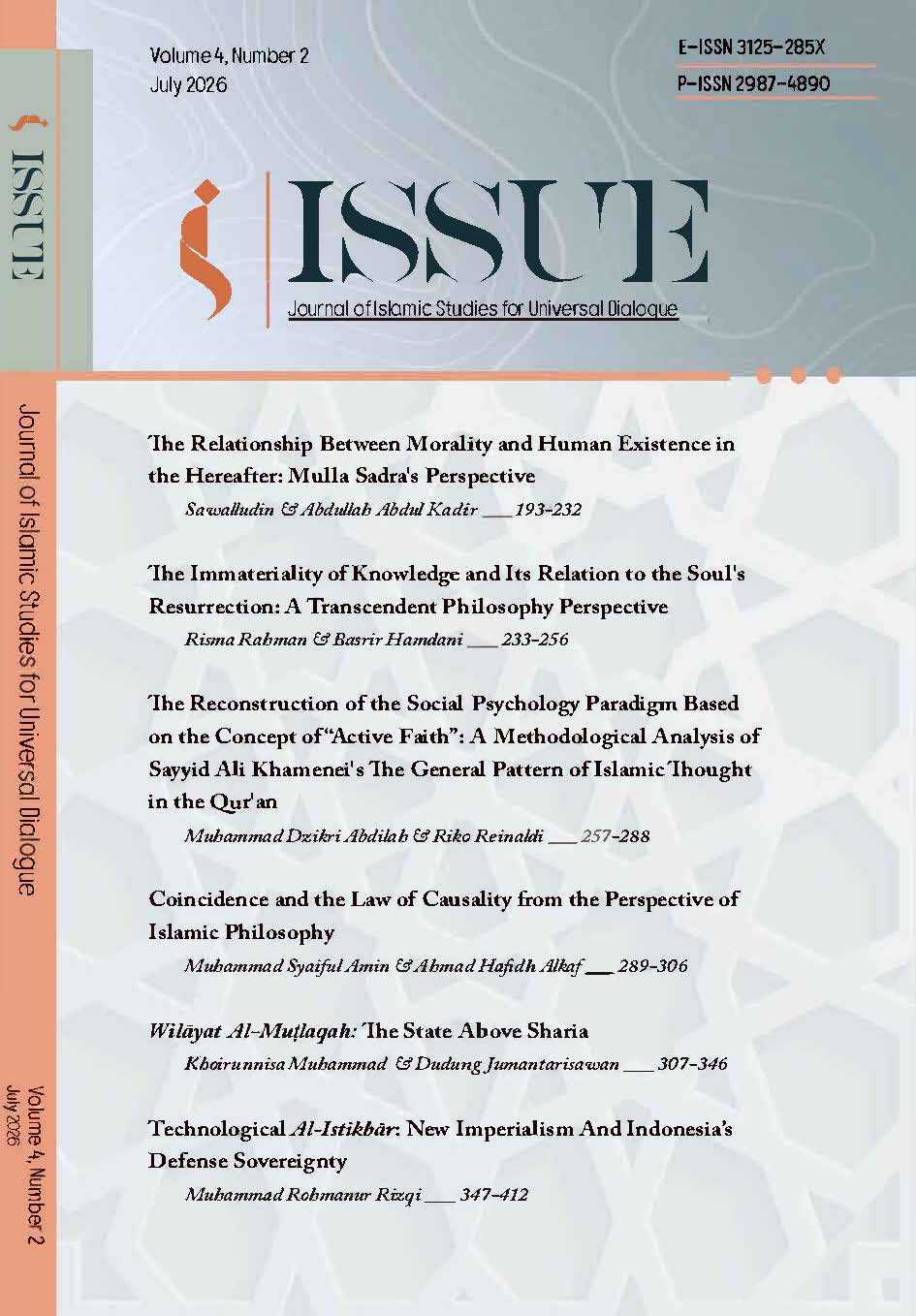
WILĀYAT AL-MUṬLAQAH
THE STATE ABOVE SHARIA
DOI:
https://doi.org/10.67281/issue.v4i2.84Keywords:
Wilāyat al-Faqīh al-Muṭlaqah, Maṣlaḥat-e Neẓām, Ḥifẓ-e Neẓām, Ḥukm Awwalī, Aḥkām ḤukūmatīAbstract
This article examines the concept of wilāyat al-muṭlaqah in the political thought of Imam Khomeini and Sayyid Ali Khamenei, as well as its implications for the relationship between the state and the sharī‘ah and the foundations of contemporary Islamic civilization. This article is based on the Friday sermon delivered by the President of the Islamic Republic of Iran, Sayyid Ali Khamenei, in Tehran in January 1988. The sermon was subsequently responded to by the Supreme Leader of the Islamic Republic of Iran, Imam Khomeini, through a letter affirming that the government of the Islamic Republic of Iran, as a continuation of the Prophet’s wilāyat al-muṭlaqah, is one of the aḥkam awwalī that takes precedence over subsidiary fiqh rulings. This article examines how the doctrine of wilāyat al-muṭlaqah moved from the theoretical domain of fiqh and kalām into the institutional design of the Islamic Republic of Iran. This study employs a qualitative method based on library research and conceptual analysis. It examines the normative arguments of the proponents of wilāyat al-faqīh al-muṭlaqah, which are then balanced with the critical arguments of reformist thinkers, such as Mohsen Kadivar, who question the origins of the concept of a “state based on wilāyat” and the potential for state domination over the sharī‘ah. The findings of this article show that, on the one hand, wilāyat al-muṭlaqah is understood as a mechanism for safeguarding maṣlaḥat-e neẓām through the instruments of aḥkām ḥukūmatī and institutional mechanisms such as the Majma‘-e Tashkhīṣ-e Maṣlaḥat. On the other hand, in practice, the designation of the government as ḥukm awwalī and the supremacy of the Rahbar create a structure that has the potential to place the state above the sharī‘ah at the level of implementation, although it continues to claim itself as the guardian of the objectives of the sharī‘ah.
References
Aarabi, Kasra. 2019. “What Is Velayat-e Faqih?” Tony Blair Institute for Global Change, Mei 13. https://institute.global/insights/geopolitics-and-security/what-velayat-e-faqih.
Abrahamian, Ervand. 2008. A History of Modern Iran. Cambridge University Press.
Alfoneh, Ali. 2013. Iran Unveiled: How the Revolutionary Guards Is Transforming Iran from Theocracy into Military Dictatorship. AEI Press.
Algar, Hamid. n.d. Imam Khomeini: A Short Biography. Al-Islam.org. https://al-islam.org/imam-khomeini-short-biography-hamid-algar.
Arjomand, Said Amir. 1988. The Turban for the Crown: The Islamic Revolution in Iran. Oxford University Press.
Ashrafi, Akbar, and Qodsī Alīzādeh Sīlāb. 2017. “Velāyat-e Muṭlaqe-ye Faqīh dar Andīshe-ye Siyāsī-ye Āyatollāh Khāmene’ī [Absolute Wilāyat al-Faqīh in the Political Thought of Ayatollah Khamenei].” Pazhūheshnāmeh-ye Enqelāb-e Eslāmī 6 (12): 23–50. https://rjir.basu.ac.ir/article_1778_fcd8653c479968bcaf34ff48029878d8.pdf.
Behdad, Sohrab. 1989. “Property Rights in Contemporary Islamic Economic Thought.” International Journal of Middle East Studies 21 (2): 223–229. https://doi.org/10.1080/00346768900000020.
Bensel, Richard Franklin. 2022. “Islamic Theocracy: The Iranian Revolution.” In The Founding of Modern States. Cambridge University Press.
Brännström, Leila. 2021. “Law’s Comprehensiveness and Sovereign Leadership: On the Juridico-political Thinking of Ayatollah Khomeini and Carl Schmitt.” Political Theology 23 (6): 541–558. https://doi.org/10.1080/1462317X.2021.2017536.
Buchta, Wilfried. 2000. Who Rules Iran? The Structure of Power in the Islamic Republic. Washington Institute for Near East Policy.
Chubin, Shahram, dan Charles Tripp. 1996. Iran-Saudi Arabia Relations and Regional Order. International Institute for Strategic Studies (IISS).
CNN. 2000. “Iran’s Supreme Leader Quashes Press Reform Bid.” CNN, Agustus 5.
Islamic Republic of Iran. 1989. Constitution of the Islamic Republic of Iran (as Amended to 1989). Qom Seminary Translation. International Commission of Jurists, 2013. https://www.icj.org/wp-content/uploads/2013/05/Iran-Constitution-of-the-Islamic-Republic-of-Iran-1989-eng.pdf
Esmaili, Mohsen. 2018. “Fiqh-e Siyāshī va Ikhtiyārāt-e Taqni’i-ye Hākim; bā Ta’kid bar Ārā-ye Imām Khomeinī (rh) [Fikih Politik dan Wewenang Legislatif Penguasa: Dengan Penekanan pada Pandangan Imam Khomeini]”. Pazhoheshnameh-ye Hoquq-e Eslami 14 (2): 13–42. https://dor.isc.ac/dor/20.1001.1.22519858.1393.14.38.1.4
Fathi, Ali Ashraf. 2021. “Negahbān-e Sonnat va Daghdagheh-ye Tahdid-e Qodrat: Vākāvi-ye Neẓām-e Fekri-ye Kohansāl-tarin Marja’-e Taqlid-e Shi’eh [Penjaga Tradisi dan Keprihatinan Membatasi Kekuasaan: Analisis Sistem Pemikiran Marja Taqlid Syiah Tertua]”. ‘Elm va Ijtihād, Februari 12. https://mobahesat.ir/12497.
Ghobadzadeh, Naser. 2023. Righteous Politics: Power and Religion in Iran. Cambridge University Press.
Hage Ali, Mohanad. 2017. “Transnational Wilayat Al-Faqih.” In Nationalism, Transnationalism, and Political Islam, 175–220. Palgrave Macmillan. https://doi.org/10.1007/978-3-319-60426-8_6.
Haghighat, Seyyed Sadeq. 2015. “Naqsh-e Maṣlaḥat dar Ḥokūmat-e Islāmī az Dīdgāh-e Imām Khomeinī (s) [The Role of Maslahah in Islamic Government from the Perspective of Imam Khomeini].” Andisheh-ye Siyāshī dar Islām 2 (6): 89–123. https://andishehsiyasi.ri-khomeini.ac.ir/article_38948.html
Iran Data Portal. 2012. “Interpretation of Article 99.” Syracuse University. November 29. https://irandataportal.syr.edu/interpretation-of-article-99.
Iran Data Portal. n.d. “The Expediency Council.” Syracuse University.https://irandataportal.syr.edu/political-institutions/the-expediency-council/. Syracuse University.
Jahanbin, Farzad. 2024. “Comparative Analysis of Feghhi Theories about the Basis of the Legitimacy of the Theory of Religious Democracy.” International Journal of Multicultural and Multireligious Understanding (IJMMU) 11 (6): 412–425. https://ijmmu.com/index.php/ijmmu/article/view/5835.
Jamalzadeh, Nasser, dan Mojtaba Babakhani. 2017. “Kārbord-e Qā’edeh-ye Hefz-e Neẓām dar Andisheh-ye Feqhi-Siyāshī-ye Imām Khomeinī (s) [Penerapan Kaidah Memelihara Sistem dalam Pemikiran Fikih-Politik Imam Khomeini]”. Dānesh-e Siyāshī 13 (1): 5–39. https://doi.org/10.30497/pk.2017.2010.
Kadivar, Mohsen. 1998a. “The Theories of State in Shiite Fiqh.” Kadivar.com, February 20. https://english.kadivar.com/1998/02/20/the-theories-of-state-in-shiite-fiqh/.
Kadivar, Mohsen. 1998b. “Theocratic State.” Kadivar.com, November 22. https://english.kadivar.com/1998/11/22/theocratic-state/.
Kadivar, Mohsen. 2017. “Ān Masā’el-e Bālātar! [Those Higher Issues!]”. Kadivar.com, November 22. https://kadivar.com/16276/
Kadivar, Mohsen. 2018. “Islam and Democracy: Perspectives from Reformist and Traditional Islam.” Kadivar.com, Mei 13. https://english.kadivar.com/wp-content/uploads/2018/07/Kadivar-Islam-and-Democracy.pdf.
Kadivar, Mohsen. 2023. “An Analysis of Shiite Political Thought.” Kadivar.com. https://english.kadivar.com/wp-content/uploads/2023/12/An-Analysis-of-Shiite-Political-Thought.pdf.
Kamrava, Mehran. 2023. Righteous Politics: Power and Religion in Iran. Cambridge University Press.
Khamenei, Sayyid Ali. 1988. “Friday Prayer Sermon, Tehran University, 11 Dey 1366 / 1 January 1988.” Video recording. Islamic Republic of Iran Broadcasting. Khamenei.ir Archive. https://www.youtube.com/watch?v=rxujyjmPa14.
Khamenei, Sayyid Ali. 2012. “A New Islamic Civilization, the Ultimate Goal of the Islamic Republic.” Khamenei.ir. March 11. https://english.khamenei.ir/news/7387/A-new-Islamic-civilization-the-ultimate-goal-of-the-Islamic.
Khamenei, Ali. 2016. “Our Goal Is to Establish a New Islamic Civilization: Ayatollah Khamenei.” Khamenei.ir. February 19. https://english.khamenei.ir/news/4248/Our-goal-is-to-establish-a-new-Islamic-Civilization-Ayatollah.
Khamenei, Ali. 2021. “Muslims’ Unity Necessary for Ralization of New Islamic Civilization.” Khamenei.ir. October 24. https://english.khamenei.ir/news/8739/Muslims-unity-necessary-for-realization-of-new-Islamic-Civilization.
Khomeini, Sayid Ruhollah Musavi. 1988. “Admonition to Ayatollah Khamenei on the Limits of the Valiye Faqih’s Authority and the Course of its Stages.” Iran Data Portal, Syracuse University. https://irandataportal.syr.edu/admonition-to-ayatollah-khamenei-on-the-limits-of-the-valiye-faqihs-authority-and-the-course-of-its-stages.
Khomeini, Sayid Ruhollah Musavi. 1999. Ṣaḥīfeh-ye Imām. Vol. 20. The Institute for Compilation and Publication of Imam Khomeini’s Works. https://islamic-sources.com/books/sahifeh-ye-imam-volume-20.
Khomeini, Sayid Ruhollah Musavi. 2008. Islamic Government: Governance of the Jurist. The Institute for Compilation and Publication of Imam. http://staticsml.imam-khomeini.ir/en/File/NewsAttachment/2014/1358-IslamicGovernment.pdf
Khalaji, Mehdi. 2006. The Last Marja: Sistani and the End of Traditional Religious Authority in Iran. Washington Institute for Near East Policy.
Mavani, Hamid. 2013. Religious Authority and Political Thought in Twelver Shi‘ism: From Ali to Post-Khomeini. Brill.
McGrath, Mats. 2025. “The Robust Autonomy of Hezbollah: Countering the Narrative of Hezbollah as an Iranian Proxy.” Skripsi/Tesis Senior, Swarthmore College. https://works.swarthmore.edu/theses/977
Mo‘allem, ‘Alī Akbarī. 2004. “Mashrū‘iyyat va Maqbūliyyat-e Velāyat-e Faqīh az Dīdghāh-e Imām Khomeinī (rh) [Legitimacy and Acceptability of Velayat-e Faqih from the Perspective of Imam Khomeini].” ‘Ulūm-e Sīyāsī 25. https://ensani.ir/fa/article/63923/.
Namozifar, Hossein. 2000. “Aḥkām -e Hokumati az Didgāh-e Imām Khomeinī (rh) [Government Decrees from the Perspective of Imam Khomeini].” Maqālāt va Barrasiha 68: 145–168. https://jmb.ut.ac.ir/article_12844.html
Papan-Matin, Firoozeh, trans. 2014. “The Constitution of the Islamic Republic of Iran (1989 Edition).” Iranian Studies 47 (1): 159–200. https://doi.org/10.1080/00210862.2013.825505.
Rāji, Sayyed Mohammad Hādi, dan Ebrishamirad. 2017. “Ta’ammolī bar Hodud-e Salāhiyyat-e Majma’-e Tashkhis-e Maslahat-e Neẓām dar Ta’yid-e Mosavvabāt-e Moghāyer bā Qānun-e Asāsī [A Reflection on the Limits of Competence of the Expediency Discernment Council in Approving Resolutions Contrary to the Constitution]”. Faslnāmeh-ye Motāle’āt-e Hoquq-e Omumī 47 (3): 655–678. https://doi.org/10.22059/jplsq.2017.226203.1453.
Sancılı, Fatih. 2025. “Wilayat al-Faqih and the Iranian Constitution: An Analysis of Islamic Governance.” Journal of Current Researches on Social Sciences (JoCReSS) 15 (4): 291-312. https://www.academia.edu/145567023/Wilayat_al_Faqih_and_the_Iranian_Constitution_An_Analysis_of_Islamic_Governance.
Tawhid, Imam Mohammad. 2026. “The Declining Legitimacy of Absolute Velayat-e Faqih: Security Implications for Iran, the Region and the World.” TRENDS Research & Advisory. https://trendsresearch.org/insight/the-declining-legitimacy-of-absolute-velayat-e-faqih-security-implications-for-iran-the-region-and-the-world/.
Vaezi, Ahmad. 2004. Shia Political Thought. Al-Islam.org. https://al-islam.org/shia-political-thought-ahmed-vaezi/what-wilayat-al-faqih.
Downloads
Published
Issue
Section
License
Copyright (c) 2026 Khoirunnisa Muhammad, Dudung Jumantarisawan (Author)

This work is licensed under a Creative Commons Attribution 4.0 International License.